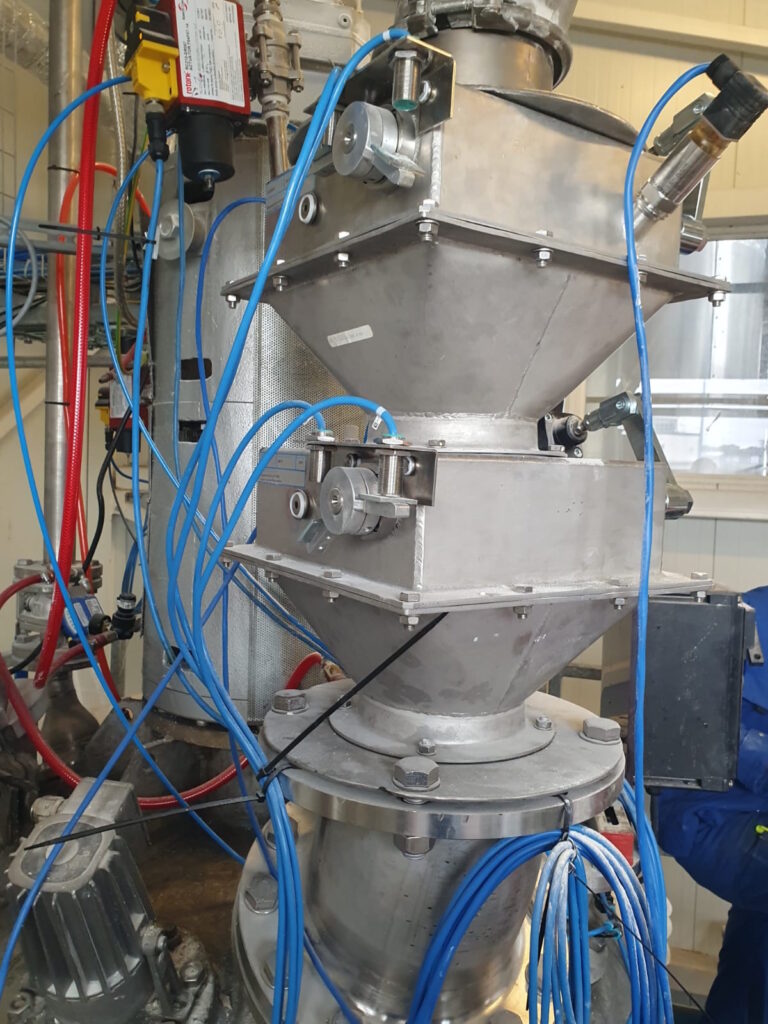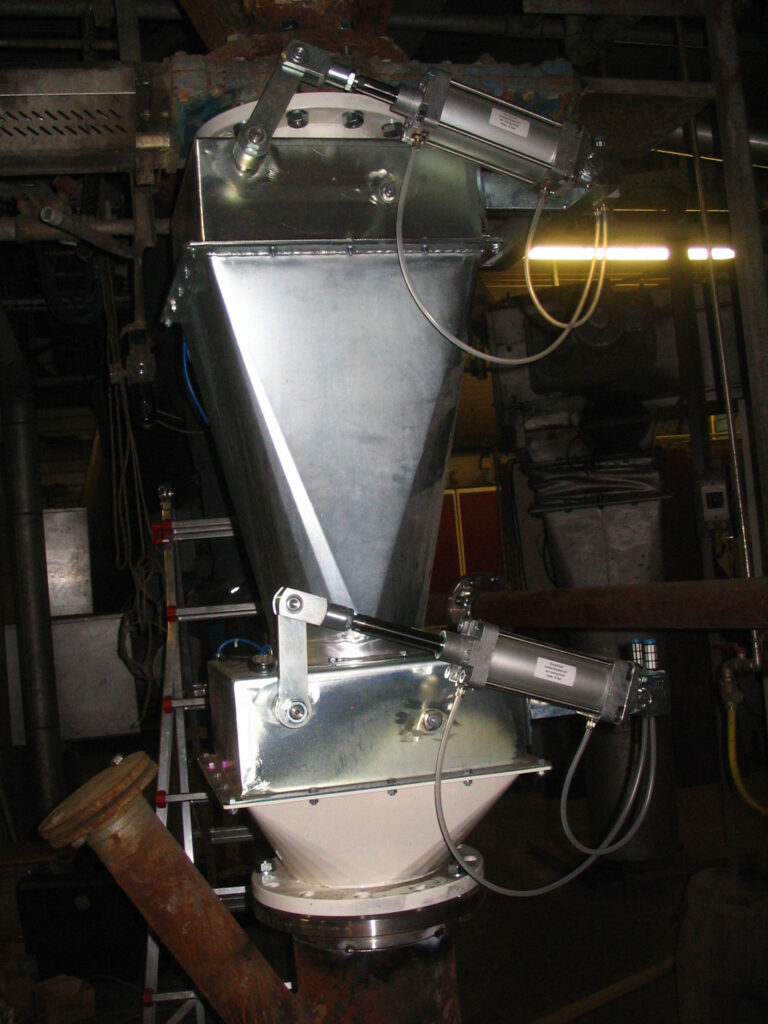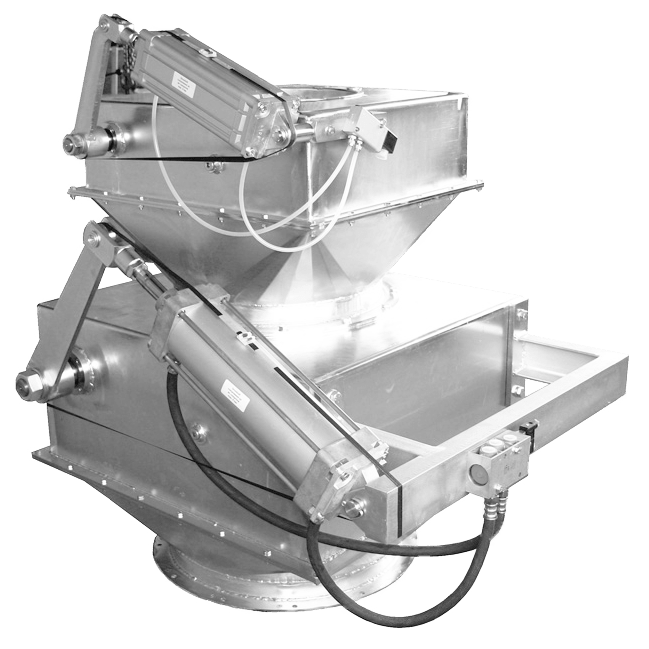
If two flap locks are arranged on top of each other, the result is a double flap sluice. It is the ideal solution for all conceivable bulk materials and solid-liquid mixtures when the container is emptied completely.
- Contains the same sophisticated mechanics as the free-flow flap.
- Feeds products or bulk materials in batches into further processes or systems and can convey bulk materials to a different pressure level.
- Hardly any wear; cannot become blocked.
- Can also be used
- At high temperatures
- With large grain sizes
- At high differential pressures and
- With large conveying quantities.
The double flap sluice is particularly suitable when transferring to a higher pressure, as the differential pressure pushes the flap against the outlet. However, when transferring to a lower pressure, the lever system and drive must be reinforced in the event of larger pressure differences.
The flap opens very quickly in the pneumatic version, so that the product flow is not diverted. Even in manually operated versions, large nominal diameters can be opened quickly with little effort when the flap is under high load.
Areas of application for the double flap sluice
- When bulk materials are conveyed to a different pressure level, e.g. when discharging from cyclones.
- When products or bulk materials are fed in and out in batches, e.g. in cement and glass production.
- When products or bulk materials are fed in batches into other processes or systems, such as feeding or discharging into incineration or biogas plants.
Functional sequence of the double flap sluice
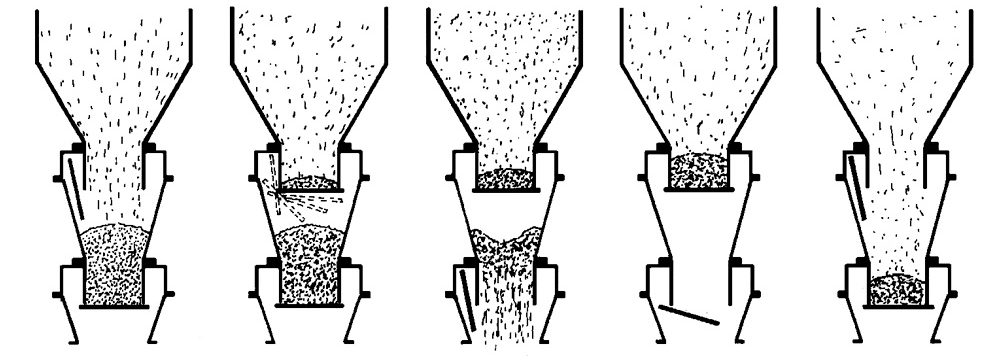
- Basic position: Lower flap closed, upper flap open
- Conveying on the lower flap until the desired quantity is reached
- Upper flap is closed
- For systems with pressure differences between discharge and feed––carry out pressure equalization
- Open the bottom flap and discharge the product or feed it to the next production process
- Close lower flap
- For systems with pressure differences between discharge and feed––perform pressure equalization again
- Open upper flap. Double flap is back in home position––lower flap closed, upper flap open
Special features
- Thanks to a sophisticated mechanism, there are no frictional or shearing forces on the seal, so that it cannot wear out.
- The closing flap swings completely out of the product flow. Therefore, the flowing product is not damaged or altered.
- As the flap swings completely out of the product flow, there is no wear on the flap.
Double flap valves are available in various designs, materials and pressure ratings.
Comparison with rotary valve
Compared to the rotary valve, the double flap sluice has no difficulties with high temperatures, large particle sizes, large flow rates and high pressure differences. It cannot block, has hardly any wear and the external air due to gap losses can be neglected.